9.23.2012

A Fistful of Fists!

Okay, more than a fistful.  I have this irksome thing where I gotta do just one more book review because if I only review twelve books the post'll seem too skimpy for me, so thirteen'll be perfect... but, hey, how 'bout fourteen!?  Etc.  That's one reason these posts aren't more frequent.  (The other reason is our hero is a lazy bastard 'bout typin' up things on computers).  But, anyway, here ya go with a new batch to make up for lost time.

(And before we get started, it's almost October, and last year we did this thing where everybody's supposed to write a horror story - the scarier the better - for Halloween.  I am, once again, casting down the gauntlet, so you should all get to work and post 'em on your blogs!  Do it!  Do two!  Or three!  Or more!  I don't care - the more the better!)

===========================


Attention K-Mart shoppers!  The reason this art looks all grim and cool and Punisher-y is because it's done by Tim Bradstreet, who did a lot of Punisher Max covers.


Jake Strait: Avenging Angel  - Frank Rich     (Gold Eagle, 1993)
Taking a noir approach to the future (perhaps using Blade Runner as a source), this is the first of four novels about Jake Strait, a free-lance enforcer (or "bogeyman") working the dismal urban future of 2031.  A corporate collapse and possibly some kind of military exchange involving nukes has finally divided the haves from the have-nots in a blatant way.   The rich live in a big gated community called The Hill while everyone else struggles to survive in a vice-filled city of scams and violence.   Everything's run by a political party known simply as The Party, and none one gets far resisting them.  Since the police won't pay much attention to crimes that don't affect the rich, you can hire a bogeyman like Jake to settle your scores, if you have the credits.   Broke and needing to put food (which is almost all soy or seaweed-based in this future) on the table, Jake takes a case for a rich couple who lead him to believe that the target is an evil serial killer.   After killing the guy, Jake learns that he was just a poet who'd written a couple of anti-Party poems, and he's been tricked into doing someone's political dirty work - a type of job he doesn't usually take.  Also the target had stolen a quarter of a million credits (which Jake transfers into his own account) and the dead man's girlfriend wants them back.   Pretty soon Jake's got a lot of different factions after him and his gun (which fires explosive jet-powered shells similar to shotgun slugs) are getting a big workout.   Very well-written with lots of great noirish lines, and Jake's realistically tough but has some humanity and a smart-assed sense of humor that keeps him on a lot of people's bad side.   Solid pacing and much more depth and skill displayed here than the usual action-series book.  Grade A stuff.


Assignment To Disaster - Edward S. Aarons  (Fawcett Gold Medal, 1955)
First of the long-running Sam Durell series has the Cajun spy stuck with finding a scientist who has vital info about the launch of a defense satellite that can fire off nukes from space.   Sam tries discovering the scientist's whereabouts through his pretty sister, but she soon becomes a target of enemy agents, too,  right after Sam develops a crush on her. And as he scrambles to track the scientist down he discovers that the situation is worse than anyone suspected; they'd thought the scientist just planned to sell the launch info to the enemy, but someone else has tampered with the rocket's guidance system so, instead of reaching orbit, it will come down in the United States with its explosive payload.  And as time's running out, Sam's own people start working against him.   Fistfights, gunplay, and narrow escapes ensue.   Solid, well-written, well-paced espionage with a sense of realism.


 This series may win some kind of prize for most covers depicting the hero with a butt goin'.  Don't smoke, kids!  But, do feel free to kill Nazis.  Surgeon general didn't say shit about that.


The Sergeant #1: Death Train - Gordon Davis   (Zebra, 1980)
First in another violent WWII action series by the guy who wrote the Rat Bastards books (the prolific and estimable Len Levinson).  Sgt. C. J. Mahoney is a hard-drinking woman-chasing misfit of dubious morals, but he's an effective soldier if only because combat provides him with an outlet for his violent nature.  He's given an assignment to blow up a bridge so the Nazis won't be able to carry troops and supplies in to counter the upcoming D-Day invasion.  Mahoney and his small band of French resistance fighters (including a couple of women so a few mild sex scenes can be fit in) decide they don't have enough T.N.T. to take down the bridge, but they can block incoming trains just as well by driving an old locomotive into a tunnel and blowing it up when the Nazi train shows up.   The SS officer he's up against is no idiot, though, and complications and some fierce town fighting against tanks results.  Like the Rat Bastards, this has loads of action, but it has more plot than I remember those having.  The writing's simple but effective (and vivid enough that a month after I read this I mis-remembered the exploding-train bit as being from a movie I'd seen!), and you get a feel for the characters and even the subplots (such as Mahoney's sidekick's romantic troubles with a married French girl) are interesting.  Great stuff!


Executioner #3: Battle Mask -- Don Pendleton  (Pinnacle, 1970)
Third book in the groundbreaking series has Mack Bolan on the run from the Mob and deciding a new face would be a useful weapon in fighting them.   He seeks out an old war buddy who owes him a couple and just happens to be a plastic surgeon.  He gives Bolan a new face (which he recovers from way too soon) and Bolan uses it to pose as an up-and-coming Mafia hood.  They accept this tough newcomer all too quickly, and Bolan feeds inside intel to the cops for a while before letting the Mafia goons know who they've stupidly welcomed in.  There are some good action scenes but they're spread amidst a lot of intrigue, and some of them are peculiar (Bolan shooting guys who've been killed in a car crash is weird).  It's also clear that helping Bolan out is a bad idea; everyone who does suffers mightily for it.  Well-written, though, and Pendleton's still a Cadillac in the parking lot of action-series writers.  (for more info, here's a review from the mucho-excellent Glorious Trash Blog)


Maybe I just coudln't get over that white turtleneck...


Stark #1: Funeral Rites
-- Joseph Hedges   (Pyramid, 1973)
Terry Harknett, who wrote the Edge Westerns as George G. Gilman, borrows his own character's name as a nom de plume for this British take on The Executioner (originally called The Revenger but it got changed to Stark because Jon Messman was already using The Revenger title for yet another Executioner rip-off).  Johnnie Stark is a cheap hood working for a mob called The Company.  He's set up to take the fall for a job, but they sneak him out of prison (in a coffin) after they determine that he's not going to fink on them.  Problem is, they kill his girlfriend, Carol Burnett (yeah, I have a hard time getting around that image, too), after hooking her on smack to control her.  Since Stark has some major grievances already, that's the last straw and he declares war.   He burns a ship carrying a big drug cargo and then -- in a very odd move since the cops are looking for him -- sneaks back to his parents' house (even though his dad hates him).  Barely escaping the cops there, he goes on the run again.  Survivors of people he kills go on vengeance hunts of their own and soon Stark's running out of friends, family, and options.  The book should have been good but it became a chore to read, and I can't really figure out why; even though there's almost constant action it all gets bogged down in overbearing detail that's not particularly interesting (I don't need an essay on every bush Stark runs over during a car chase), and there's an overabundance of cardboard characters waiting to be gunned down.  The writing is more than competent but still lacks punch somehow, and even when Stark's on the run the story doesn't feel like it moves.   It's like a treadmill in high gear.  It won't let you read it fast, even when you should be, so it gets annoying.  But maybe it's just me; it did have some good points, but the overall impression was bleh.


Killsquad #1: Counter Attack  - Frank Garrett   (Avon, 1986)
Gung-ho Dirty Half-Dozen actionfest as a hardass CIA specialist -- code-named The Hangman -- pulls six killers off of death row so he can channel their ruthless bloodlust against international terrorism.  What a great idea!  What could go wrong?   Three of them are white and three are black and all (except for one who may have been framed) are pretty much a bunch of bastards.  There's not much room in a short book that's preoccupied with action scenes to almost a Rosenbergerian degree for characterization, so the author (Dan Schmidt, I think) uses pretty broad types -- an ex-Klansman, a German neo-Nazi, angry black guys, etc.   Most of the guys aren't all that well-drawn (I can't count how many times one of them's referred to as "the one-eyed pirate" just to remind us of who he is) and the bad guys aren't characterized at all beyond being referred to as insulting-terms-for-Arabs, so you're left with a whole lot of guys you don't really know or have anything invested in shooting each other and blowing things up.   You do have a LOT of that, though; the book's lacking some things (characterization, coherent plot, etc.) but there's no shortage of action.  Our heroes -- who mostly hate each other -- are given a little training and then sent to fight an army of jihadi terrorists.  When the characters aren't calling each other racist things (does anybody actually call black people "Chads" or was that made up for the book so it wouldn't be full of something really offensive?), the author's calling the Arabs "dung-eating scum," "Prophet's droppings," etc., so if you're overly offended by political incorrectness in your trashy men's adventure fiction, you should probably read... I dunno, the Chopper Cop might be your only option.  The faceless action gets overbearing, but it's not badly done, just scant in the plot department.


Bronson: Street Vigilante #1: Blind Rage - Philip Rawls   (Manor Books, 1975)
First in a loose 3-book series, and one of the most blatant rip-off series ever -- this wants to be Death Wish so hard they named their hero after the movie's lead actor.  And I use the word "hero" hesitantly in regard to this book, because Richard Bronson (not to be confused with goofy millionaire balloonist Richard Branson, who, to my knowledge, has murdered absolutely zero street-scum... but he's just reaaaally good at getting away with it.  Hmmmm... Branson: Balloon Vigilante!  I'm writing these now, damnit!  Why not?  You can dump any kind of garbage on a Kindle for free!) is as sick and sadistic as any of his targets.   The book cover makes a big deal out of him being some big liberal, but that's not really in the book; he has no conflict with himself and  flings himself instantly into a bloodthirsty quest for vengeance when his wife and children are murdered by depraved psychos, who are ludicrously set free by the courts because they're identical twins.  Bronson sets up housekeeping with a 17-year-old Latina who admires him all too much as he not only gets even but indulges in Sadean orgies of torture; he pours drain cleaner on a guy's genitals and face, emasculates and eviscerates another with a broken bottle, sets a woman on fire, feeds somebody to rats, and shoots a dozen or so others, never having any trouble getting away with it even though cops suspect him.  He also has no trouble putting together an arsenal including illegal items such as silencers and submachine guns; gun store owners give him whatever he wants, no problem.  As bad as Bronson is, the bad guys he kills are even worse, raping children and making snuff films.  Of course, Bronson also kills some less-guilty people, too, wiping out anyone who could be a witness.  At one point he smashes the skull of a puppy!  I don't think Dennis Kucinich would do that even if you murdered everyone he knew.  For all its sleaze, moral ambiguity, and gratuitous racism and gay-bashing (this author has a major hang-up about homosexuals), it's well-paced and solidly written, much better than the usual, with a wide variety of action -- car chases, gunfights, torture, etc.  Worth seeking out if you like 'em extreme.  (I had to dig this one out of my stacks and re-read it after reading this killer review on Glorious Trash, so go read that, too)


Did I mention in the review that Johnny Morini is 150 feet tall?  Well, he is, as you can clearly see by this cover art.  Soldatozilla!


Soldato #2: Death Grip!    - Al Conroy (Lancer, 1972)
Former Mafia soldier Johnny Morini is bailed out of a small-town jail after a bar brawl (he has kind of a drinking problem) by a dying millionaire who wants him to continue his vendetta against the mob, and has set up a trust fund to finance it.  Not having much else to do with his miserable life, Johnny starts hijacking trucks, turning over crooked poker games, repeatedly throwing an attacker down flights of stairs... all as a means to infiltrate the Mafia so he can play havoc with it from the inside.  When he gets in, the mobsters ironically want him to infiltrate a rival gang, so here we go again.  He starts robbing grocery stores and such to work his way in.  Once they accept him he uses his unique position to pull a Fistful of Dollars thing and set the two rival gangs against each other, tricking them into wasting all their muscle in a big mob war.  Johnny goes a little too far, though, when he double-crosses them on a jewel heist and gets himself in big trouble.  The writing here is much higher caliber than the usual series book, and the action scenes are tough, tense, and frequent, and they stay fairly realistic, with Johnny taking a beating and getting into a few situations that only luck can get him out of.  Worth looking for.

The Hulk called and he wants his arms back.  Ye godz!  Admit it, you'd buy this book just for that cover.


My Name Is Black - Joseph Nazel  (Pinnacle Books, 1973)
What if Mack Bolan was more like Mack BRO-lan?  That's basically what this series was attempting, creating a Blaxploitation take on The Executioner.   Our hero, simply named Black (if he's got a first name it's none of our business), is "a six-foot 180-pound ebony monolith of rage," and was a 'Nam vet and a boxer who "hit harder than income tax."   They syndicate demanded that he take a dive in a fight and he told them to go fuck themselves, so they sent a couple of goons around to break his hands and he beat them both to death.  He's sent to prison for that and while he's there they rape and kill his sister (which apparently causes his mother to die from grief -- we know she dies too but Nazel forgets to mention why), and Black spends a year in prison constantly working out and preparing himself for a vengeance rampage.  When he's paroled the mob still wants a piece of him, too, and he takes part of a shotgun blast that only seems to piss him off.  He turns into a one-man riot, burning down syndicate drug dens and businesses and blowing off the heads of mobsters with his .357 Magnum and M-16, with both the cops and the mob trying to catch him.  The writing's not flashy but does what it sets out to do, capturing a Blaxploitation movie feel, and even though the plot runs pretty thin, it's got no shortage of mayhem -- the body count is large but not out of the realm of plausibility, and the action is constant, so it's got pacing working for it.  Black is Back was the only sequel.


Black Berets #1: Deadly Reunion - Mike McCray  (Dell, 1984)
A corrupt CIA agent has use for an old team from Vietnam, supposedly to free a POW in Laos, so he wrecks their leader's career so he'll have no other options but to rebuild his five-man team (which is so racially diverse it might as well be called the Rainbow Coalition instead of the Black Berets).  None of them have really adjusted to civilian life very well, anyway, so it's not difficult to convince them.  The leader, half-Cherokee Billy Leaps Beeker, has been living in the woods where he killed a couple of rednecks who were torturing a mute Indian orphan he unofficially adopts.  His buddy Cowboy has been trafficking (and using a hell of a lot of) cocaine.  Torture-expert Rosie, a big black guy, has been peeling corpses in a morgue to make bandage for burn victims.  Greek Harry has been running a bar and feeling sad and empty.  And Navy Seal demolitions expert (and dangerous lunatic) Applebaum has been blowing things up for a construction company.  Billy Leaps gets them back into fighting shape at his Louisiana compound and then it's off to Laos, where their mission holds some dangerous surprises for them and gives them a reason to keep the team together and make a second book in the series (which ran for 13 volumes).  The writing here is far, far better than most of the men's adventure genre; in fact, it's just about perfect pulp writing.  A lot of these "team" books suffer from weak characterization, with so many people to juggle, but this one makes these guys stand out and take on lives of their own.  I read the first several books in high school and could still remember some individual scenes decades later, which is a pretty amazing testament to the writing when most action-series books are forgotten a few hours after you finish them.  The action's well-handled and doesn't skimp on the gore.  Damn-near perfect stuff.  Mandatory.
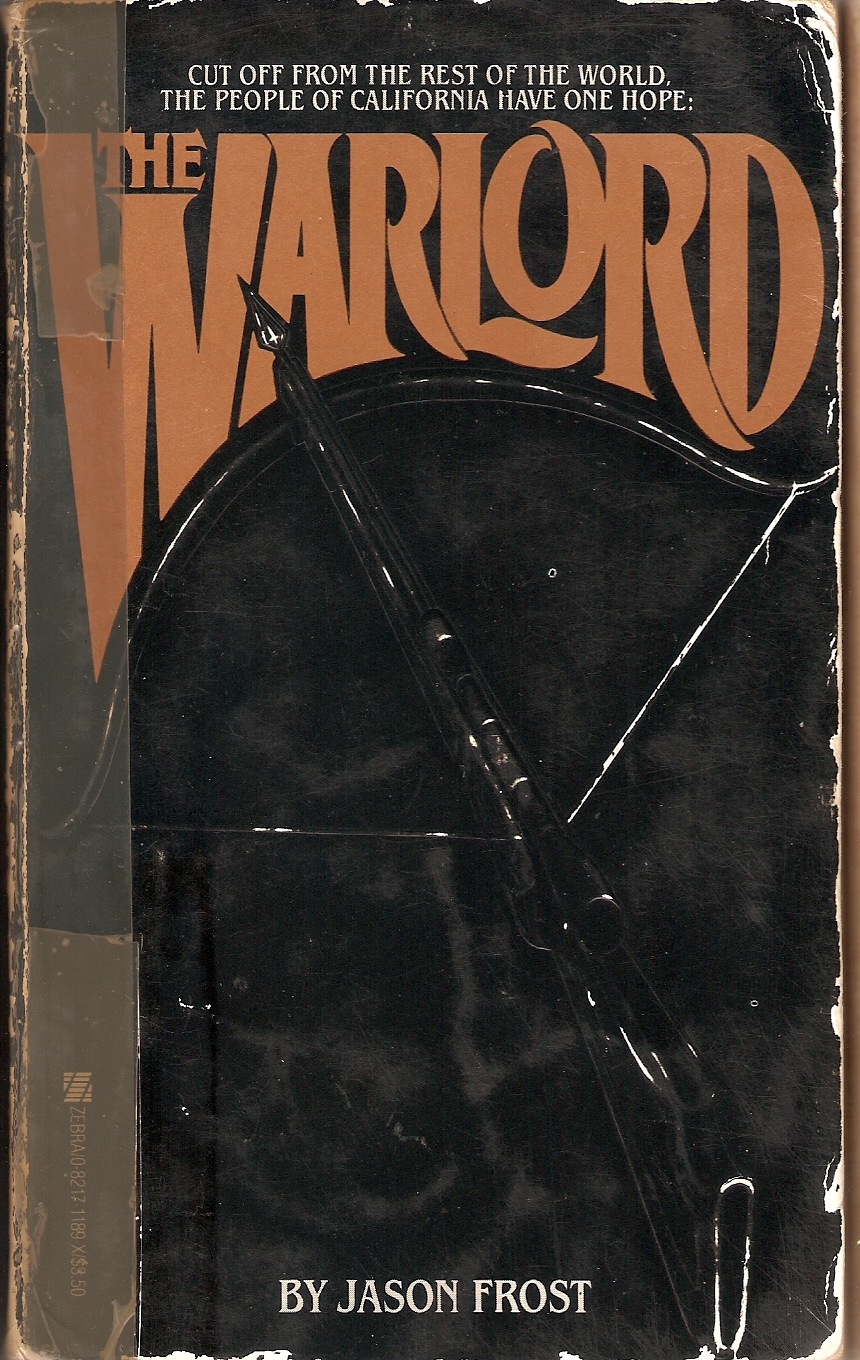
That tape was on the cover when I bought it... I'd've had enough sense to at least use the clear kind.


Warlord #1 - Jason Frost   (Zebra, 1983)
Eric Ravensmith is a nice-guy history professor who conveniently happens to be a former member of a Vietnam unit called "The Night Shift" who were super-secret ultra-violent Green Beret types, plus he was also raised and trained in fighting by Hopi Indians.  Ravensmith is testifying against his former Night Shift commanding officer, Dirk Fallows, a Shakespeare-quoting psychopath who crucified women and children and then left Ravensmith for dead when he tried to intervene.  Fallows and his goons have targeted him and his wife and kids, and Ravensmith -- who just wants to be peaceful and doesn't even keep guns in the house -- is having to fend off the malevolent bastard's attacks.  This terrible situation is made even worse when a series of massive earthquakes break southern California off the continent, leaving it five miles from the mainland and surrounded by a toxic dome of acid fog created by chemical and biological weapons that had secretly been stored in Long Beach.  The police have all firearms confiscated to minimize the anarchy, and survivors form little tribes to survive.  Ravensmith's group lives on the old university campus and he protects it with bows and arrows, including a crossbow.  Other groups are hostile and try to strong-arm his people into trading them things (such as books from the library), and Fallows is still out there with his psychotic henchmen, still wanting revenge on Ravensmith.  Fallows starts murdering Ravensmith's family, which turns him into a cold and ruthless killer, leading a group of volunteers after Fallows... and that is anything but easy.  This series seems to be an action-oriented take on The Stand (the author's a pretty obvious Stephen King fan, with that "Night Shift" business and a "Dead Zone" -- Under the Dome would be a sure fit if this book didn't pre-date that one by decades) and the writing is above average and full of interesting details, such as survival facts.   Characterization is solid and the fights are good, but they do run a little thin, considering the book's an overlong 400 pages.  Still, very much worth seeking out.  The series sported what has to be the most boring cover art in all that action-series world:  each of the six books bore the exact same diagram of a crossbow, and only the colors changed.


The Interlopers - Donald Hamilton  (Fawcett Gold Medal, originally 1969)
Hardass spy Matt Helm has to impersonate a dead man and keep his appointments with some spies.  He's given a Labrador Retriever much like the murdered agent's and is sent off to do some fishing in the woods, where he'll get slipped little pieces of coded info to store in the dog's collar.   But the other side wants to take him out so another substitute of their own chosing came make all of his meet-ups instead.  Helm's kept in the dark about his mission more than he likes (he has a vague idea it's concerning an assassination attempt on the president or a presidential candidate) and more and more trouble comes up at him and bodies pile up.  As the pieces of the puzzle start coming together, Helm doesn't even trust his own people anymore and resists pleas to get off the case, and it sets him on a collision course with one of the other side's top assassins, who gets the upper hand.   Luckily Helm bears no resemblance whatsoever to the silly-ass Dean Martin imitation (this is a very gritty and realistically-violent book) so he just might make it out alive.  Tough stuff with no false heroics (one character complains to Helm that he keeps shooting his enemies in the back, but Helm's about getting the job done and living through it) and things seldom go the easy way.  The writing is top-notch and knowledgeable -- you can learn things from these books.


Fox #2: Prize Money  - Adam Hardy  (Pinnacle, 1973)
Ambitious asshole George Abercrombie Fox continues his career in the war-torn British Navy of the early 1800's.  As punishment for being caught screwing his captain's mistress, e's reassigned to an ill-regarded ship, Sheridan, under Captai Tranter, who's a bit of a madman.   Fox doesn't like it there much, so he gets himself reassigned (and nearly court-martialed) when he provokes the captain's madness by tweaking his obsession with imaginary pigeons he thinks live in the rigging by serving a seagull at dinner.  He's moved from ship to ship and engages in battles with the French until he finally ends up in charge of The Raccoon, which captures French ships that are sent to supply Bonaparte's armies in Egypt.  Fox tries for as much cash as he get capturing ships but is then assigned to transport statues from Spain to England, which handicaps his quest to profit off the destruction of the French.   There are some brutal naval battles but Hardy isn't forgiving if you don't know your way around an old sailing ship or 19th century life at sea; I had to figure out a lot from context and learn on the fly, because Hardy (aka Kenneth Bulmer) is not going to hold your hand; this is strictly immersion-method storytelling.  It's character-driven stuff, with Fox pretty full-fleshed as a character; he's mean and self-serving, though not without redemptive moments of compassion, such as when he risks the ship to rescue a sailor who fell overboard during a battle.   He's also got an interesting flaw -- he goes blind in one eye during moments of great stress, which he's under pretty often.  Hardy's writing captures the time period and confidently covers a great deal of time in a short number of pages.   I've also read the first one but looking back, my review was so skimpy that this one covered pretty much everything I said in it, so I just included the cover of it as a bonus.

========================================

Meanwhile, on Twitter...

9.10.2012

Figplucker's 21st Century Blues: Cypress Grove (Skip James)


Another Skip James tune... this time, the creepily resigned Cypress Grove. I was aiming for atmosphere on this one, with a concerted effort to make it sound sorta distantly swampy, though my slide guitarwork is resoundingly subpar. Whatever. You decide. And, please... let me know what you think.

Click the songtitle to hear it. Right-click to download.


Assholes of American History...


9.01.2012

Figplucker's 21st Century Blues: Hot Dog (Led Zeppelin)


Here... have a Hot Dog...
(Oh, wait... it's invisible...)
Yeah... this one's kind of a cheat, I guess. It's not an old blues, it's a Zep tune. But, lots of their stuff actually was old uncredited blues, so whatever... water from the same well, maybe just a little more British (which would make the water taste like it had bad dental care?)... 

When drummer Matt + Donny Guitar + I were still trying to put together a coverband to hit the clubs, we recorded some tunes, including the already-posted Sunshine of Your Love and this... Our cover of the way-on rocked-up country blues offa Physical Graffiti...  


(Cuz it's Labor Day Weekend, see...?)
Anyway, Donny's guitar playing on this one is rather tasty, so check it out + then post some nice things here about his playing... he's been a little depresst lately + it'd cheer him up!

8.28.2012

The Complete Nick Carter: Killmaster -- this is what obsession looks like

Yep, I done went 'n' done done it.  I collected all the freakin' Nick Carter series.  That's 261 books, as detailed here on this wonderful website which was invaluable to me in this insane endeavor.  Naturally, I didn't go back to the 1800's and collect the old detective pulps and dime-novels (info on those here)  - I stuck to the Killmaster books.

Luckily, I got the bulk of these really cheap, by haunting used bookstores, where they were a buck at most, and a lot of 'em were fifty cents, a quarter, etc.  My dad was a huge reader of Westerns but I had a couple of Nick Carter books around and told him to try them, and he got into them in a big way.  My dad got around the world quite a bit and he was impressed with the accuracy of the Nick Carter writers in depicting places he'd been.  So, much of this collection got built by buying him presents for Christmas, birthdays, father's days, etc. -- he didn't care if they were used and I'd usually get him like 20-30 books at a time, so, they built up fast.  When he died, I inherited 'em, and noticed I was only shy around 40-50 of 'em.  They're still fairly cheap from Amazon marketplace or ABEBooks, often going for just the price of shipping... so, even though $4 is a little more than I'm used to paying for used books, I chipped away at it, and finally got the last ones in today.

So, feast your eyes on what a complete set of Nick Carter books looks like, and admire my dogged persistence, or despise me for being a hoarder of junk, depending on your viewpoint (both are probably equally valid, but still fuck you if it's the second one!).


And here's what the same pile looks like with a stupid bad cat named Thirteen in front of it:

And here's the same cat lying down to rest from the exhaustion of his intense not-giving-a-shit-about-a-giant-pile-of-old-paperbacks:


And here's a couple of close-ups because I know a lot of you people are like me and have a fetish for the individually-unique wear 'n' tear of around 20-to-50-year-old paperback spines and this is like porn for you (and a beauty you'll never find from those goddamned fucking e-books):


 I wish you could smell them.  It's beautiful... the cinnamony smell of aged paper is like nothing else.

Now, all I need is the secret of immortality so I can read all this stuff.  So far I've read, ohhhh, maybe a dozen of 'em.  Never read a bad one (they're usually better than most series books).   And my dad read over a hundred and wrote "good" or "very good" in all of 'em 'cept two.  Those are pretty good odds, 'cuz my dad was often a harsh critic... you should read some of the stuff he wrote in the few Longarm Westerns I got him. Yikes!

(Now go follow people on Twitter).


8.23.2012

Figplucker's 21st Century Blues: Trouble Blues (Charles Brown)

Another blues about dat ol' trubble...
This time, it's Charles Brown's 'Trouble Blues' from the late 1950s... Gave me a chance to try out recording that new/old Hammond I scored a while back...

Hope you like... let me know what you think!

8.07.2012

East of Rulesville - a guest short story

 A friend of mine offered up a short story for the blog, and I've read this guy's writing before and love it, so I jumped at the chance.  I'm glad I did, too, because this story kicks much ass!  He said I should use "proftbolt" as his blog pen-name, so, that's what I'll do.

The file he sent was double-spaced and had some strange returns here and there, so I've edited the format to look better on the blog  (I've made mistakes in formatting before, and hence you have my apologies if you've tried to read that one - I need to re-format that someday, 'cuz the story itself's not bad, I think).   I didn't change any of the content, I just added paragraph breaks when speakers changed in the dialogue, or in other places where spacing looked like they belonged.  In any case, if the paragraphs aren't spaced correctly, that's my foul-up, and Proftbolt's welcome to point them out and I'll fix 'em.  And thanks for letting me post it!

Anyway, I think ya'll're gonna like this.  It's strange, and will definitely make you think.  Enjoy!

=================================================

East of Rulesville by Proftbolt


    The sun's excruciating heat was pounding down on Paul. The dry dust kicked up by a passing caleche seemed to hover around his face like gnats swarming around a light pole in an empty parking lot. The thick brown mist seemed to be just waiting for the moment that he opened his jaw wide to choke him on the tiny sand particles.   

    "Don't start with a weather report," he said aloud, but low enough so that only he could hear the murmur. He remembered his old creative writing instructor telling him all of the rules of writing: never start with a weather report, old fat Dr. Baker used to say. Never start with a weather report.   

    Paul watched as a blue and white taxi drove by very slowly. The driver, with a dark complexion, banged hard on the side of the door and shouted, "Taxi? You go take taxi? You go take taxi now?"    Paul shook his head no, tried to avoid eye contact, and looked back into his yellow legal pad. The words just weren't coming to him. He looked at the young man in the blue galabiyya who had just offered him hashish only minutes ago. Why do they always offer him hashish, he thought. I don't know why they always pick me out. Do I look like someone who would want hashish? He watched as the young man turned to follow a German tourist. Paul could hear the tourist say, "Sprechen zie Deutsch?" and the young man responded with a resounding, "Ya!"    Write about what you know, he could remember frumpy old Dr. Baker say. What did he know? Well, he grew up on a farm outside of Dayton. His summers were full of playing basketball under the makeshift hoop attached to the old red barn. He played tag and rode his bike, jumping over ditches and pop cans. What did he know of the hot noonday Egyptian sun? What did he know of pharaohs and lost civilizations? Cicadas returning after a long, long sleep. That's what he knew. Sticky summer afternoons while sitting under a tall, tall oak. That's what he knew. But what the hell did he know of this ancient land and of the ancient people?   

    He saw out of the corner of his eye another man starting to approach him. Probably somebody else trying to sell him some plastic Anubis, Paul thought.    

    "Fine day, sir," said the man. He wore a tan galabiyya, torn and frayed at the bottom. His feet, rough and dry calluses evident on the sides, were shod in worn out sandals.   

    "I don't want any," said Paul as he averted his eyes to look back across the Nile. The wind blew small rhythmic waves.   

    "I am not selling."   

    "Then what do you want?"   

    "To tell you it is a fine day along the Corniche. Is not the Nil beautiful?"

    "Yeah," said Paul. "It's beautiful." Make sure the dialogue is believable, how people really speak, he heard Dr. Baker chastise.   

    "I have something I want to show you," the man said.   

    I've heard that one before, thought Paul. "I thought you weren't selling anything?"

    "Oh, my friend," said the man. His teeth had large gaps that his thick tongue tried to fill. "What I have is not for sale."    Make the plot organic. Make it grow. Make it flow, Dr. Baker would say, pointing and jabbing with his thick fingertip. "What is it?"

    "Oh, I have to show you. Come. You come now." The man waved at Paul before Paul realized his cultural mistake. He started to wave "bye-bye" before he caught himself. The man repeated his motion, and reached out to touch Paul's hand. Paul noticed the tremendous contrast in their hands. The man's hand was very dark on the outside and surprisingly light underneath at the palm. But all over were very rough spots, bumps protruding. Paul's was very white and smooth.   

    Description should be at a minimum, only there to propel the story, the gruff Dr. Baker would say, running his hand down a long list of rules. You should follow these rules if you want to be a great writer. All great writers follow these rules, Dr. Baker would often say, and caress the handout as if it were the Rosetta Stone. But Paul often thought differently. Rules are made to be broken, aren't they?   

    "Okay," Paul found himself saying, not really realizing that he was now standing, his hand resting in the two dark, callused hands of his newfound friend. The man smiled, his turban slipping down over his brow as he did so.   

    "Come. Come. Come," the man repeated. "Come my friend."   

    Paul did as he was told, and, hand-in-hand, walked with his newfound friend. Funny, Paul kept thinking. In America, people might stare at two men holding hands, but in this country, a country that frowns on homosexuality, that's okay. They walked down the sidewalk until it ended and turned to dust. Then, quickly, the man took a right down an alley. Days before, Paul had explored this very same alley but only briefly. As soon as he moved into the alley, he was swarmed by merchants trying to get him to come into their stores, to purchase their wares. He was besieged by little boys trying to sell him trinkets. He was swarmed by young men trying to practice English with the foreigner. "Where are you from?" They would shout. "America," Paul said. "Aaaaah, America," they shouted back. "America No. 1. Egypt No. 2. You very, very good. You come to my store, yes? Come. Look at my store. What is it you want? I have all. You want silk? I have silk. You want Nefertari? I have Nefertari."

    But now, no one approached him. Instead, they all looked at him, and when his eyes met theirs, they were the ones who quickly cast them downward. No one spoke to him. No one offered him anything. No one tried to lure him into a store. As long as he was tethered to his new friend, he was an untouchable. He watched his boots kick up the dust with every hard smack to the dirt alleyway. Flies buzzed around the fresh produce and around his head. He heard the muezzin haunt the evening air. He heard the Egyptian music pound in the shops. Arabic voices bounced all around him, but as he passed, all seemed momentarily quiet.    

    Finally, his newfound friend said, "Come. Inside here," and pointed to a very thin doorway down a tertiary alleyway. Paul ducked his head as he went through the doorway, and he entered a small, dark room. There was only a chair for furniture. A young female squatted by the chair. "Come in here. Look." Paul squinted until his eyes adjusted to the difference in light.   

    "This is my daughter. Take her," the man said.   

    "What?" Paul said. Surely he heard wrong. Perhaps the man said something in Arabic, but it sounded like something else in English. "What did you say?"   

    "Please, take her."   

    "I can't take your daughter. That's . . . "

    The man interrupted him. "But sir, please listen. You are a rich American professor. . . " Paul stopped listening to the man for a moment, trying to figure out how this man knew so much about him. How did he know he was a professor? How did he know any information about him? He turned to look the man in the face to try to pick up what he was saying. ", , , and you have the means to take my daughter across the border, out of Egypt. I cannot."   

    "Wait, wait, wait," Paul said. "I don't follow. You want me to do what?"

    "Take my daughter out of Egypt. I know you are a good man. I know you are a kind man. I have been told about you. I have been told that you rescue strays, no?" His voice cracked a bit before a smile slipped out.   

    "How do you know me? I've never met you before. How do you know so much about me?"   

    "Let's just say, we have a mutual friend."   

    "Who?"   

    "There's no time for that, friend. Please, you must take my daughter, and you must take her tonight, after midnight."   

    "Take her where?"   

    "Go to the pier tonight. There will be my cousin Ahmed. He will take you out on a felucca. From there, he will dock with a motor boat, and it will take you past Alexandria. From there, there will be a bigger boat to take you across the Mediterranean to a little village in Turkey. Once you get to the other side, my cousin Muhammad will be there. That is all I ask. Once you have delivered her to Muhammad, your duty is over. He will take her to Hamburg where she will have a chance of a better life."   

    "But why me?"

    "Again, you rescue strays. You must. You cannot resist. Allah wills it."   

    "But why do you need to get your daughter out of Egypt?"   

    "If she is still here by sunrise, I am afraid they will kill her."   

    "Why?"   

    "She was raped. She is no good now. She cannot marry. She must go."   

    "If she were raped, then it's not her fault."   

    "You don't understand, my friend," the man said as he started to pace. He darted his eyes back and forth from the doorway to Paul. "That does not matter. Here, she is looked upon as the temptress. She is, how do you say, damaged goods. It does not matter if she consented or not. She is still no good. I love my daughter. After my wife died, she is all I have left, so I must get her out of here."   

    "But what about the man? The one who raped her?" Paul asked. Something told him he should not ask, but he couldn't resist. He looked at the young girl, still squatting. Now that his eyes had started to adjust, he could see a small kitten curling up around her ankles.    

    Don't waste time on unnecessary details, he could hear old Dr. Baker say. He generally wore a plaid jacket with leather patches on the elbows, and whenever he espoused his rules, the patches would shake.   

    "Aaaah," the man said, stroking his chin. "He will be punished, too. But not in the same way. That is the way. That is our way. You must not question."   

    Two more men walked into the tiny doorway, and the man addressed them in Arabic. They seemed to be arguing slightly, but since Paul knew only bits and pieces of Arabic, he wasn't sure. About all he could make out was the "salaam" of peace when one man addressed him.   

    "You must take her," said one man. "It is her only hope. You came looking for something to write about. Well, here is your chance." He did not wait for a reply. He turned and walked back out of the door, his sandals clopping hard against his heels.

    The other two men remained, said nothing, and stared at Paul. He was starting to feel uncomfortable. Maybe, he thought to himself, if I agree to it, they'll leave me alone, and then I can sneak away.    When he told the man in the doorway, the one with the fuzzy mustache, that he would do it, the man grabbed Paul's face, kissed him on both cheeks, and told him to wait there. The wetness still remained as Paul peered into the darkness.   

    Paul was now alone with the girl. He felt that as odd, a westerner alone with a young, unmarried female.   

    "What is your name?" He was not sure if she could speak English or not.   

    "I am going by Ruby," she spoke, but her voice was very low, almost a whisper.

    "You speak English?"   

    "Yes, for three years now I am speaking English at the school."   

    "Ruby? That's not a very Egyptian name."   

    "No. That is what father says I am going by now. It says in this little book." From underneath a fold in her clothing, she produced a passport. Paul immediately recognized the blue cover as being American. So that's it, Paul spoke to himself. She has a fake passport, and I guess I'm to pose as her father or something to get her out. Or am I getting involved in some kind of underage, illicit sex trade business, Paul thought. His mind was receiving many, many images about now. Is this really a good thing, or am I just being used here?

    "I am going by Ruby, like the singer," she said softly. Every so often, a flash of light would penetrate the darkness, and Paul could see her pouty lips glisten. "You know Ruby? I love Ruby. I want to be just like Ruby. I love Ruby and her snake. My father say she is evil, but I want to be just like her."   

    "You . . . you . . . were raped?" Paul hesitantly asked, peering into her eyes that seemed to twinkle in the moving darkness.   

    "Yes."   

    "I don't understand. If he forced himself on you, then why are you in trouble?"

    The little girl looked up from the kitten. Her eyes, even in the approaching darkness, were very vivid. Paul could tell that they were green. He was reminded of that famous photo of the girl from Afghanistan. Her skin was the color of coffee after about four or five packets of cream have been poured in.    "It is the way. I do not question."

    "Yeah," Paul started to prod. Perhaps he could use this for one of his stories. He walked all along the Corniche yesterday, writing down all of the images. He watched the donkey carts full of dung go up and down the street. He watched the street peddlers hassle tourists. He saw the Bedouins drink strange brown liquids, squat in the sand, and laugh at the women as they passed. He wrote it all down. But nothing struck him as much as this fated Egyptian girl. He thought she might be about thirteen. She seemed like a Third World Juliet. With no one guarding the door, this would be a wonderful time to slip out, to disappear, and get away, but something in the little girl's eyes drew him in. Something in the story kept him riveted.    Keep the reader engaged, Dr. Baker always said.   

    And he was.   

    "Yes," he tried to correct himself from using too much slang. Perhaps she will not understand me. "But you could not help it. He forced you."   

    "Kind of," she said. "I am, how you say, temptress, like Ruby. Like Jezebel."

    "But that's not true, is it?"   

    She started to move closer to him. She looked into his eyes. "Yes. I wanted to be near this boy. I lifted my dress. He could not help himself." As she moved closer, she tugged at her hem and Paul could just make out, in the faint light penetrating the dark room, a little tattoo on her upper thigh. From Paul’s research, he thought he could recognize the silhouette of the god Bes.

    "So, you wanted him to force himself on you?"   

    "Only attention. I like him. I wanted attention. I did not want, how you say, fuck."

    Paul was startled by the word. It seemed so ugly, so out of place, especially coming from this small girl.    "But now, now that I am, as father say, tainted, all I can do is fuck. I must go to Hamburg, father say, where I fuck. I make money. I live."   

    "Is that it?" Paul realized. You have to become a prostitute? That's not right. Paul was now thinking about how he could help this poor girl. Perhaps the man was right. He did take in strays. Perhaps he could go along with the plot until later when he could rescue this girl. Perhaps he could run away with her. Perhaps he could hide in her eyes.

What a tale this could make, Paul thought to himself.
   
    She started to move closer to him. "But, the boy. He no fuck me."   

    "But, I thought . . . " Paul seemed to get more confused. He started to inch away from her, clawing at the dirt floor. He could feel the cool earth seeping in under his fingernails.   

    "He think he do, but he do not. I am still whole."   

    "But, then, why don't you tell your father?"    "Because I wanted him to. That is sin enough." She moved even closer to Paul, her hand now moving up his thigh. Paul noticed his khaki pants starting to wrinkle up. He watched as she slowly moved higher and higher up his thigh, her smooth palm groping, groping, groping until it finally rested on his crotch. Her hair was surprisingly brown and curly as it fell down over him.

    "What are you doing, Ruby?" He said the name, emphasizing it as if it seemed as out of place as this girl grabbing at him. He moved his hand down to push hers away, but instead, he slowly caressed the backside of her wrist. Her hand moved quickly to his zipper, and before he knew it, he felt her hot breath. Paul couldn't control himself.    Ruby's head shot back quickly. She smiled. "Oh, not long," she said, and Paul felt embarrassed.

He heard voices outside, and he quickly grabbed his pants by the belt loops and fumbled with the zipper.
   
    Two men entered the tiny hovel, two men he had never seen before. They looked at him lying on his back, scrambling to get to his feet but only able to rest upon his haunches. They looked at the young girl who was now smiling and wiping at her mouth with the backside of her wrist. They yelled at him in Arabic and jabbed fingers in his face.

    "I didn't. I don't know what you're saying," Paul tried to protest, but neither man seemed to understand English nor even care. “I’m an American,” he blurted out. “You can’t do anything to me.”   

    One of them grabbed him by his collar, yanked him to his feet. Paul looked to the fading light shining through the doorway and tried to move toward it. The other man blocked his path, butted into him with his shoulder, and then spat in his face.   

    "I didn't . . . she did . . . " Paul tried to say, but the two men started hitting him in his stomach. The blows were more surprising than painful. He wanted to say how he didn't do anything, but all that came out was "ummph."   

    Paul fell to his knees, and one man continued hitting him, punching him in the face. Paul could feel the solid and rough hands pressing up against his eyes, his nose, his mouth. They'll stop, soon, Paul thought. They are just angry, but it will subside. Maybe the man in the tan galabiyya will show up again. He'll explain everything. I'll give them money.   

    But they continued to punch him, and when Paul slumped over into the dirt, face first, they started kicking him with their bare feet. One started stomping on his head. Paul could see the man's bare sole crushing down on his face. Showing the bottom of the feet is considered to be quite rude in the Muslim culture, Paul kept thinking to himself. How rude of this man. Here I’m getting pummeled, and all I can think about is cultural etiquette, Paul thought to himself. The thought made him smile a little, but the smile exposed his teeth, allowing a toe to smash into his open mouth. There was blood, but Paul couldn’t tell if it was blood from his gums or blood from the man’s toe, cut on his sharp tooth.   

    Then, he saw a shiny blade of metal appear. He always read about the coldness of the blade. That's what creative writers always say. The blade was cold. But it wasn't.  It was not cold at all. In fact, it seemed to burn as it entered his body. But once there, he felt nothing.   

    He could see Dr. Baker standing in front of him, wagging his finger. Now remember, you can't have the main character die, because if he dies, who tells the story?

    I guess that's good news for me, thought Paul, as the two men picked up his limp body, blood leaving a trail of red drips out of the doorway. I guess that's good news.

    The men put Paul on the back of a donkey cart. He could smell the manure that had been there earlier in the day. As the donkey brayed and started to move, he could hear the call to evening prayer just ending, and he could see the little girl waving to him off into the distance. She was waving goodbye.

    Or was she waving for him to come closer?

8.03.2012

Difficult lives...

Hola, amigos.   I know it's been a long time since I've rapped at ya, but I've been readin' like a motherfather, from a wide variety of things, from the highest literary art to total (presses palms to mouth and blows really hard) - classics to trash and all points in between.  These don't fit my usual horror or men's-adventure genres, but they do have a unifying factor:  they're all about troubled, desperate people living rough lives. Beyond that, well... just go read the reviews, that's what they're here for!


The Cheaters - Orrie Hitt (Stark House, originally 1960)
Tension-laden tale of lowlife desperation that was originally considered a smut novel, although the sex (while frequent) isn't half as graphic as what you'd find in most Westerns now.  A loser named Clint is down to his last ten bucks and wants to keep his girl, Ann, so he takes a job as a bartender in a dive bar in a slum district.   Much of the bar's business is built around the prostitutes who work the area, and a corrupt local cop named Red is shaking down the bar and whores for protection money.  Clint gets Ann pregnant and then drops her because he's obsessed with his boss's wife, Debbie, because she has size 40 tits and he is that  shallow of a sonofabitch.  He buys the bar from his boss and starts making more money, partially by upping the amount of prostitution going on.   Clint's life gets more and more desperate as Red chain-whips him to keep him away from Debbie, who Red wants for himself, and Debbie won't leave her husband because she wants to collect on his life insurance, and a strike on the docks cuts Clint's clientele way down... and he starts making dangerous plans.   This is a very well-written story of people with few options and a lot of personal flaws to which they are captive.  Their pursuit of happiness only makes them more miserable and gets them into deeper and deeper trouble.  The story’s sleazy, by necessity, but can’t be dismissed as just smut, because the writing is too good and there’s too much social truth captured here.  Hitt wrote like a fiend, hammering out novels in two weeks sometimes, publishing around 150 books with titles like Trailer Tramp, Abnormal Norma, Torrid Wench, etc.  This one comes bound with his Dial M For Man.  Hopefully Stark House will resurrect more of his work, because his writing is strong enough to turn trash to art.


McTeague - Frank Norris   (Library of America, originally 1899)
Brilliant masterpiece in which a hulking, strong, stupid self-taught dentist goes from a life of impoverished-and-lonely contentment to married, wealthy misery of hellish proportions.   McTeague is a slow-witted, shy, awkward guy who falls in love with one of his patients, who happens to be his only friend’s girl.  The friend likes the idea of being magnanimous so he says he’ll step aside, and McTeague marries the girl, who is also poor-but-content.  Then, by happenstance, she wins $5,000 in a lottery she didn’t even want to buy a ticket for, and that happy event soon turns into a nightmare that just gets worse and worse.   McTeague’s friend starts resenting him out of jealousy, his wife turns into a money-obsessed miser (when she didn’t have it she didn’t miss it, but now that she does she wants more and more just for the sake of collecting it), and McTeague gets a taste of the finer things so he’s no longer content with the simple pleasures he used to have.  And then he misses those things when his wife’s crazed money-hoarding leads them to a life of pointless squalor.  A couple of subplots are as interesting as the main one; a housemaid with mental problems drives a money-hungry man (an unfortunately racist portrayal of a Jew) crazy with tales of a gold set of eating utensils that never even existed, and an old man and woman try to carry on a romance of sorts even though each is too timid to even look at the other.  Norris’s writing is great and extremely readable; for a book so old it’s an amazing page-turner, and it’s realistic (Norris’s claim to fame), detail-rich, and fearlessly dark.  I had heard this was one of the great novels but was still surprised at exactly how great.  Highly recommended.   Basis for Erich Stroheim’s silent classic, Greed.


The German - Lee Thomas  (Lethe Press, 2011)
During WWII, a killer murders young men, leaving pro-Nazi notes written in German in their mouths.  A wave of paranoia is inflamed against the Germans in the community, and violence against them soon follows.  One of the German citizens, Ernst Lang, is scarred from WWI and is left rather abrasive and cynical.   When local kids discover that Lang is also homosexual, the paranoia about him is doubled, and Lang won't be able to expect much justice for the treatment he'll get; even if he's not guilty of any crime, just being German and a "queer" will be enough for people whose fear has blinded them to the danger of demonizing "types" instead of seeing individuals.  Powerful, well-written, and insightful; this is somewhat of a horror novel, although the darkness here is the kind made by human weakness.   In parts it's reminiscent of Jack Ketchum's The Girl Next Door (without reaching quite those harrowing extremes) and also reminded me a little of Paris Trout.   It was a little hard to get into at first -- Thomas has a formal literary style -- but after a point I flew through it.  Impressive and important.


To Each Their Darkness - Gary A. Braunbeck  (Apex Publications, 2010)
An expansion/revision of Braunbeck’s earlier (limited, i.e. expensive) Fear In A Handful of Dust: Horror As A Way Of Life, this is kind of Braunbeck’s version of Stephen King’s Danse Macabre - like an overview of the genre -  but it’s more of an autobiography of a fan steeped (and working) in the genre.  He doesn’t do much detailing the history of horror, because if you’re reading this book you can be assumed to know about The Castle of Otranto and the rest of it.  Instead, Braunbeck tells you (with brutal candor) about his life (and oh my fucking GOD has it been a tough one -- he never whines about it but trust me, you couldn’t blame him if he did) and how what he’s learned from it has shaped him as a writer/reader/viewer.   It’s very opinionated (but that’s what you’d buy such a book for, right?) and extremely well-written, and even when you disagree with him on some things, you can’t help liking and respecting the guy.  He tackles only a limited number of books and movies, many of them not conventionally considered horror (such as John Cheever’s The Swimmer), and intelligently discusses them, with enthusiasm; he’s convinced me I need to watch Seconds again.   A lot of material previously published is used here -- articles on Stephen King movies, a eulogy for J. N. Williamson, prefaces and afterwards to other books -- but only the prefaces and afterwords  (although interesting) really felt like filler.  The flow from chapter to chapter can get  a bit clumsy and non-cohesive, but there’s so much good in here that it’s easy to overlook a few flaws.  And the autobiographical sections will have you nailed to the book.  If you’re wondering why I put a nonfiction study of the horror genre in a blog post of book reviews based on “difficult lives,” read this and I don’t think I’ll get any argument.  Important and recommended to any non-casual horror fan.


To Have and Have Not - Ernest Hemingway (Scribner, originally 1934)
Hemingway apparently tries to go noir in this multiple-viewpointed tale of a fishing boat captain, Harry Morgan, who tries to bulk up his struggling finances by doing something he really doesn’t want to risk doing -- carrying smuggled people from Cuba to the U. S.   His ill-fated border-crossings always end up with someone dead, and he eventually loses an arm while smuggling liquor.  Harry is stubborn, racist, and hard-assed about what goes on on his boat but wants to provide for his family (it might be more effective if we saw them -- they’re barely mentioned) and eventually what he’s doing will cost him.  The novel’s written so tersely you almost can’t tell what’s going on at times (one major character dies and I couldn’t figure out that’s what had happened until several pages later), and it changes viewpoints a lot -- first it’s written first person from Harry’s point of view (the strongest section), then switches to third person, then back to first person but from another character, etc.   Then, after awhile, it dispenses with Harry altogether and follows some drunken tourists who are fouling up their relationships.  It starts strong then starts to meander and lose itself; I’m not sure it’d be considered the classic it is if Hemingway weren’t so overrated.  It’s not bad, there are some good lines, but also lots of babble and pretense.  Hemingway considered it his worst book, and “a bunch of junk.”  It’s better than that, but it’s also overrated.


“Reds” - Jack W. Thomas (Bantam Books, 1970)
Hilariously dated sleaze as a couple of 15-year-old girls -- Dorcie the hard-boiled know-it-all who’ll do any damn thing as long as it’s bad, and Polly, her wanting-to-be-cool-and-stupid-like-Dorcie tagalong -- set out to make the hippie scene on Haight.  Armed with money stolen from their parents and whatever pharmaceuticals they can scrounge up or score (including birth control pills and Dorcie’s beloved reds - seconal) they kidnap a “square” guy named Cole to take them there.   Cole doesn’t mind much because he’s intrigued and kinda likes Polly, but Dorcie soon proves to be a drug-fueled psychopath, and she’s the one in charge of everything.  She wrecks Cole’s father’s Lincoln in a chase with the cops, almost gets them all raped and killed in a bad deal with some mean hippies, and takes them to a drug house where a big black guy who calls himself “King Coon” wants to impregnate the girls to further his master plan of creating one unified race.   Polly and Cole start a sort-of romance (as close to one as too-jaded-for-such-square-things Polly can deal with, anyway) while Dorcie starts shooting up reds instead of popping the pills, goes completely, dangerously insane on LSD, and starts thinking how trippy it’d be to shoot Polly and Cole so she could be alone with her stuffed animal.  Dorcie ends up wandering around with her face painted and some guy’s severed dick in her purse.  And of course the whole thing implies “don’t let this happen to you (or your kids).”   The book’s full of slang so extreme and extinct it’s almost like reading the NADSAT stuff in A Clockwork Orange, and everyone’s a degenerate.    Even though the book wallows in the idea of orgies it balks at getting too explicit with the descriptions.  The writing’s okay and the story moves, if a bit disjointedly, but it’s pretty silly even though it’s aiming for the tragic.   You get the feeling Thomas got ahold of a drug-slang glossary from some cop and tried to use every word in it.  I figured out that “groove” is how he thinks “groovy” is spelled...


The Twisted Cross - Ann Pinchot  (Paperback Library, 1964)
Psychology textbook masquerading as a novel.  After a local girl is found strangled, then raped, her psychologist (named Mary) is approached by a minister named Douglas, who thinks he may have killed the girl during a blackout.  The rest of the book is Mary psychoanalyzing Douglas and figuring out how his hatred of his mother and abandonment by his father have given him anger towards women, homosexual tendencies, and all kinds of neurotic feelings.  The story is clumsily handled because that doesn’t seem to be what Pinchot was interested in -- mostly it’s just analysis, and a good deal of that is dated.  It’s marketed as a horror novel comparable to Psycho but it’s barely even a novel at all.  Not completely dull, but without much point other than to show off what somebody learned in psychology class.  Blah.


The Short-Timers - Gustav Hasford (Bantam 1979)
One of the all-time greatest war novels.  This Vietnam story was the basis for Full Metal Jacket, which was pretty faithful to the book but changed a few things and -- believe it or not -- watered them down.  R. Lee Ermey's drill sergeant was lovable compared to the sadistic psychopath in this book.  And the section spent in Vietnam is darker, bleaker, and more violent.  Full Metal Jacket is one of my favorite films but the book is even stronger stuff.  It's compulsively readable; the prose is simple but every other line is quotable.  It's a travesty that this thing is out of print.  Very fast read which I'll likely be revisiting often.  


One Is A Lonely Number - Bruce Elliott  (Stark House, originally 1952)
Larry Camonille breaks out of prison because conditions there would kill him soon; he's lost a lung to tuberculosis.  He wants to make it to the warm dry climes of Mexico but doesn't have money to get there, so he hides out for a while in Ohio, washing dishes in a roadhouse while he tries to scheme enough money to let him keep going.  A couple of women he sleeps with want to give it to him... but in exchange for some bad things they need him to do.  One wants her mother-in-law killed so she can get her hands on her late husband's money, and the other inherited some bonds but Larry would need to hold up a banker to get them.  And he's figured that at least one of these women is setting him up for a big fall instead of the payoff they're promising.  And then his life gets even more complicated, but that might not be a problem for long if he can't find a way out.  Gritty and pretty uncompromising in the sex department for its day, this is classic noir by a guy who mostly wrote a few Shadow pulps under a pen name.  Strong, bleak desperation without easy answers.


The Hunchback of Notre Dame - Victor Hugo   (1831)
Imposing classic is more readable than you'd think, but is still drawn-out in excessive melodrama.  A beautiful gypsy girl, Esmerelda, enchants everyone in 15th century Paris by dancing in the streets.  Her most dangerous admirer is Claude Frollo, a priest who's so obsessed with her he's driven to almost become a rapist.  His adopted son is Quasimodo, a hideously deformed hunchback who's full of hatred for the world that scorns him, but who is capable of great humanity when shown some kindness.  Esmerelda, who'd shown pity on Quasimodo, becomes accused of witchcraft and a tangled web makes Quasimodo her protector, but Claude Frollo is as big a threat to her as the enraged mob and the king's guards.   It's overlong, and there are obsessive passages about the architecture of Paris that distract from the narrative almost as badly as the "whale" chapters distract from Moby Dick, but it's still a great, important work of literature that's also a pretty good read.


Hunger - Knut Hamsun (Barnes & Noble, originally 1890)
Our unnamed narrator for this angst-driven classic is an unsuccessful free-lance writer in Norway, who spends the book in desperate straights, both because of cruel fate and his own actions; the guy's a lunatic to begin with, and he's being driven even madder by malnutrition,.  Unable to find any sort of job and only rarely managing to sell anything he's written, he's pawned everything he owns that he could get a shilling for; in one ridiculous moment he even tries pawning the buttons off his coat.  He has to struggle for every cent, but if he somehow gets any money he often gives it away, apparently to create the illusion (mostly to himself) that he's not really so badly off.  He's so starved that he tries eating chips of wood, and when he does get any food he throws it back up because his body doesn't know how to handle it anymore.  His hair starts falling out and his clothes get ragged, and the only friend he has is a woman who's interested in him because she thinks he's a madman.  While he starves (and resists the urge to ask for charity) he acts crazy, harassing people in the street with bizarre "pranks" (like following a woman around yelling that she's going to drop her book -- and she's not carrying one) or telling ridiculous lies to strangers and then starting arguments by accusing them of not believing him.  His situation gets more and more desperate as he's always on the verge of being homeless;  his landlords are always just about to kick him out of the palces he stays, and the starvation's giving him writer's block so there seems no way out.  This is pseudo-stream-of-consciousness stuff, more concerned with the protagonist's thoughts and feelings (the reader will often understand what's happening better than the narrator's megalomaniacal perceptions allow him to), and there's not much plot.  It does keep you reading, though, just to see if this goof will ever get his shit together.  Hamsun ended up a pariah in Norway because his conservatism led him to welcome the Nazi occupiers (he even gave Goebbels his Nobel Prize medal as a gift and wrote a tearful eulogy when Hitler died), so that's tainted his reputation considerably.  But taken as a work divorced from the character of its author, this is a worthwhile read.


Want more? Hell yeah you do!  And you can get it by following me and a bunch of other people on Twitter.  Here's how.

7.20.2012

Look at my huge organ! Just look at it!

Filed from the Weirdly-Poetic Timing Dept...

Jon Lord, organist for Deep Purple + formerly-solid candidate for the most interesting man alive, died earlier this week. An innovative cat, to be sure, with powerful Hammond B-3 chords stabbing thru the band's sound, juiced up thru a Marshall stack...


And synchronicititilly, I found a Hammond organ available locally this week, for only $50! Of course, it ain't a top-o'-the-line B-3 or anything at that level, but it IS a perfectly functioning VS-300 (entry-level unit: no drawbars, shortened keyboard range, no Leslie cabinet)... so now my studio is really coming together, albeit as a room full of weird old vintage gear... Anyway, here's some pictures! 

 Along with the Hammond, you'll see my rack full of vintage Ibanez effects units (UE-400, UE-405, HD-1500... + not pictured: UE-303B, DUE-400), my Yamaha SY-1 (monosynth ca. 1974), an Alesis HR-16 (16-bit is the shit!) and some other stuff.


All of it (except the Hammond) was used in the making of the Mighty Blowhole album posted here a few weeks ago. So, if you're curious as to what some of these things sound like, there ya go...